

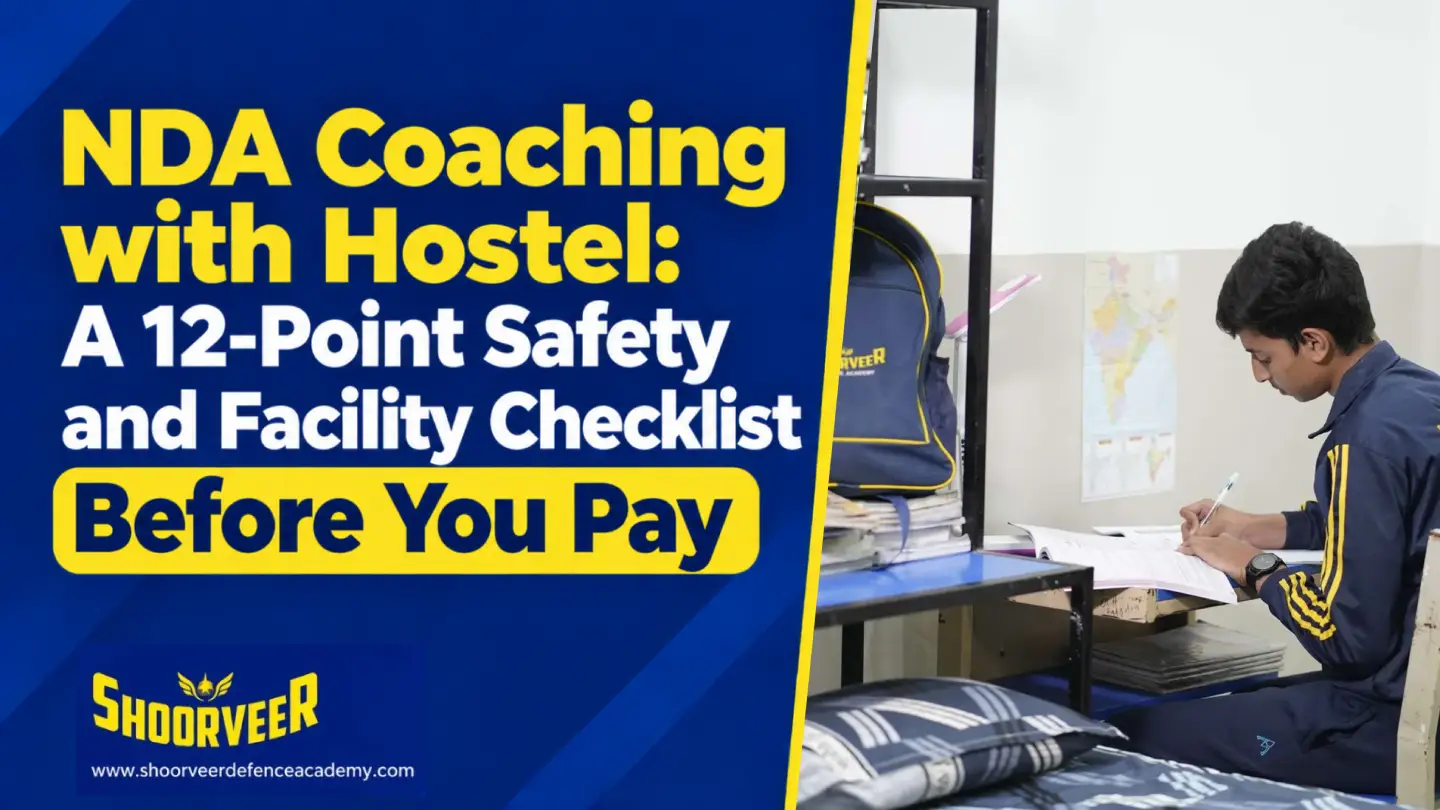
NDA coaching with hostel is only as good as 12 things you can check: working CCTV, controlled entry, accountable wardens, medical care, a clean mess, decent rooms, clear visiting rules, fair discipline, reliable communication, fire and emergency readiness, a proper study space and, for girls, a genuinely separate and supervised hostel. Below we explain how to test each one, what we publish about our own hostel, and what we ask you to see and get in writing.
A quick note for readers outside India: NDA here means the National Defence Academy, the joint services academy where future Army, Navy and Air Force officers begin training. Entry is through a UPSC written exam and an SSB interview after Class 12. “NDA coaching with hostel” means residential coaching, where the student lives on campus and follows a fixed daily routine.
We run ShoorVeer Defence Hub on a 35-acre residential campus in Jhunjhunu, Rajasthan, for students from Class 9 to Class 12 and after 12th. Parents hand us their children, so we think they should check us the way they would check any hostel. We have written this checklist to be used on us and on every other academy on your shortlist.
The 12 checks at a glance
| # | Check | What a good answer looks like | What we publish today |
| 1 | CCTV | Common areas covered, footage stored, someone watching | Campus-wide CCTV, and 24×7 CCTV at the girls’ hostel |
| 2 | Biometric access | Entry is logged, visitors are recorded, locks release in a fire | Biometric access at the girls’ hostel |
| 3 | Wardens | Named people, on site at night, women for a girls’ hostel | Female wardens at the girls’ hostel, and a named Hostel Director |
| 4 | Medical | First aid, a doctor on call, a clear route to a hospital | On-site medical care |
| 5 | Mess hygiene | Licence, clean kitchen, rotating menu, a meal you can taste | In-house meals at fixed times |
| 6 | Rooms | Known occupancy, ventilation, hot water, backup power | Air-conditioned rooms, a gym and a theatre |
| 7 | Visiting rules | Written days, hours and an authorised pick-up list | Regular parent-teacher meetings. Visiting hours not published |
| 8 | Discipline | A written rulebook, no physical punishment, a safe way to complain | Weekly room and fitness inspections. Rulebook not published |
| 9 | Communication | A named contact, call windows, fast alerts | Phone and email published. Student phone rules not published |
| 10 | Fire and emergency | Certificate, drills, marked exits, backup power | Not published. Ask to see it |
| 11 | Study space | Quiet hours, supervised halls, doubt support | Two daily self-study blocks and a daily doubt-solving slot |
| 12 | Girls’ separation | Own entry, female staff, supervised mixed events | A girls’ hostel with CCTV, biometric access and female wardens |
The last column is deliberate. Where we have not published a detail, we say so, and we ask you to get it in writing.
The 12-point checklist, one by one
1. CCTV: where it points matters more than how many
What to check. Cameras only help if they cover the right places and someone acts on what they record. Ask where cameras sit (gates, corridors, the mess, study halls, play areas), how many days of footage are stored, who can view it and who watches the live screens. Cameras belong in common areas, never inside rooms or washrooms.
How we answer. Our programme pages describe round-the-clock security and CCTV surveillance across the campus, and 24×7 CCTV at the girls’ hostel. On your visit, ask us to walk you through where the cameras are and how long footage is kept.
2. Biometric access: ask what happens in a fire
What to check. Controlled entry gives a record of who went in and when. Ask who is on the access list, how visitors are logged and what happens when the system fails. The question most parents miss is whether electronic door locks release automatically during a fire or a power cut. A locked door that will not open is a hazard, not a safeguard.
How we answer. The girls’ hostel has biometric access. For boys’ hostel entry and visitor logging, ask us what is in place, and watch how the gate handles you when you arrive.
3. Wardens: a named person beats a headcount
What to check. Ask how many students each warden looks after, whether wardens stay on campus overnight, who covers nights and holidays, and whether the wardens of a girls’ hostel are women. A named, reachable person matters more than a ratio on a brochure.
How we answer. The girls’ hostel has female wardens. Mr. Kurdaram Dhinwa is our Hostel Director, and you can see him named on our About us page. We have not published warden numbers per block, so ask for them.
4. Medical care: separate three things
What to check. “Medical facility” can mean three very different things: first aid on campus, a doctor or nurse on call, and a quick route to a hospital. Ask who is on site at 5:00 a.m. when physical training starts, how far the nearest hospital is, who takes a sick student there and how fast parents are told. In Rajasthan, also ask how outdoor training changes in peak summer heat and in the cold of winter mornings.
How we answer. Our pages state that on-site medical care is available. Staffing, hours and hospital arrangements are not published, so ask for all three, plus our process for informing parents.
5. Mess hygiene: taste is not the test
What to check. Visit the kitchen. Ask to see the food-business licence (FSSAI), how drinking water is purified, how often the menu rotates, how allergies and special diets are handled and whether students can give feedback. Eat a full meal there. Cadets training twice a day need enough calories and protein, so ask who plans the menu.
How we answer. Our meals are prepared in-house. The published timings are breakfast 7:00 to 7:30 a.m., lunch 12:00 to 12:30 p.m. and dinner 7:30 to 8:00 p.m. We have not published a menu, so ask to see it and to eat with the students.
6. Rooms: ask who shares with whom
What to check. Find out the occupancy (single, double or multi-bed), whether rooms are air-conditioned, and how they are ventilated. Look at beds, cupboards, bathrooms per student, hot water in winter, laundry and backup power. Then ask a question few parents think of: do Class 9 students share rooms with Class 12 students? Age mixing changes who a young child spends nights with.
How we answer. Our pages describe clean, modern, air-conditioned hostel rooms, with a well-equipped gym and a theatre for movie nights. Room occupancy and allocation by class are not published, so ask which room type your fee covers.
7. Visiting rules: get days and hours in writing
What to check. Ask for visiting days and hours, where parents meet children (a visitor room, not the hostel floor), who may collect a child (an authorised list), what the leave rules are for festivals and emergencies, and how a parent reaches a child at night in an emergency.
How we answer. Our 11th, 12th, after-12th and girls’ programme pages list regular parent-teacher meetings to update parents on academic and personality development. Visiting days and hours are not published, so ask us for the written visiting and leave policy.
8. Discipline: strict is not the same as safe
What to check. Military-style routines are part of NDA preparation, and they work. The line to watch is where discipline ends and harassment begins. Ask for the written rulebook, how breaches are handled and who is allowed to punish. Ask for physical punishment to be ruled out in writing, and ask what happens when one student bullies another. A student should have someone other than their own warden to report to.
How we answer. Our routine is military-style, with weekly hostel room discipline inspections and weekly physical improvement inspections. We have not published a rulebook, so ask for it and read it before you pay.
9. Communication: who do you call at 11 p.m.?
What to check. Ask for call windows, how emergencies are handled, how often parents get updates, how quickly you will hear about an illness or injury and the name of one person responsible for your child’s hostel life. Ask what the rules are on phones in hostel rooms, since they affect both sleep and focus.
How we answer. You can reach us on +91 72403 72408 or at info@shoorveerdefencehub.com, and regular parent-teacher meetings are part of the 11th, 12th, after-12th and girls’ programmes. Student phone rules are not published, so ask for them.
10. Fire and emergency: ask to see the paper
What to check. Look for fire extinguishers, a valid fire safety certificate, marked exits, night evacuation drills, backup power for lights and CCTV, and safe wiring for air-conditioning loads. Ask when the last drill took place and what the plan is for a night-time emergency.
How we answer. We have not published fire and emergency details on our pages. Ask us to show you the fire safety certificate, the last drill record and the evacuation plan. If any hostel cannot show these, think twice before you pay it.
11. Study space: a hostel should help you study, not just sleep
What to check. Look for quiet hours, supervised study halls, enough desks and light, a reference shelf or library, and a clear way to get doubts solved after class. Ask how phone use is limited during study time.
How we answer. Our published weekday routine has two self-study blocks, 7:30 to 9:00 a.m. and 8:00 to 10:30 p.m., plus a doubt-solving slot from 3:00 to 5:00 p.m. You can see the full day on our 12th NDA foundation course page. Our guide on how to balance school academics and NDA preparation shows how to use those blocks.
12. Girls’ separation: separate, supervised, and clear about shared events
What to check. For a girls’ hostel, ask whether it has its own entry, whether female wardens and staff cover nights, who may enter and when, and how any mixed activity is supervised. Ask for the answers for the hostel itself, not only for the campus.
How we answer. Our girls’ hostel has 24×7 CCTV, biometric access and female wardens, and the Prerna Batch for girls runs inside this setup. Our programme pages also list a weekly cricket match between girls and boys. Ask us how it is supervised, and how the girls’ hostel is separated from the boys’ hostel.
Eight questions to ask any hostel, and get answered in writing
The checklist covers what you can see. These questions cover the money and the risk, and they apply to every academy you compare.
- What exactly does the hostel fee cover (room, mess, laundry, electricity, medical, exam fees), and what costs extra?
- What is the refund policy if my child leaves after one month, or midway through the year?
- If my child falls ill, who decides, who goes with them and how quickly will I hear?
- Is there accident or health insurance for residents?
- Who is the named person I call about a hostel problem, and who do they report to?
- Has the hostel had a serious incident in the last year, and what changed afterwards?
- Can I speak to two current parents without your staff in the room?
- Can I see the hostel on an ordinary day, at mealtime, and not only on a show-round?
A confident hostel answers these without hesitation. A vague answer to question 6 or question 7 tells you more than a polished brochure.
Visit once, in 60 minutes
A campus visit beats any brochure if you use it well.
- Arrive at breakfast or dinner. Eat with the students and notice how they talk to staff.
- Walk from the gate to a room. Notice who stops you, who logs you and who walks with you.
- Look at the dull things. See the medical room, the kitchen, a bathroom, a study hall and the fire exits.
- Ask a student, not a guide. “What would you change?” is a better question than “Do you like it?”
- Read the rulebook and the fee terms before you leave, and ask for the fire safety paperwork.
If you cannot travel yet, take the virtual campus tour, which includes a hostel section. You can also browse the “Hostel life” and “campus life” sections of our photo gallery. Both help you shortlist, but neither replaces a visit.
Is a hostel the right choice for your child?
A hostel suits a student who needs a fixed routine, wants daily physical training and does not want a long commute, and who copes well away from home. It can also suit a student whose family lives far from a strong school.
Think twice if your child is unsure about a defence career, lives near a good day school and studies well alone, or has never spent a night away from home. Younger students deserve extra questions about homesickness: ask how staff help a Class 9 child settle in, and read about our 9th NDA pre-foundation batch to see how the early years are structured. The decision has to work for years, not for the first month.
For the SSB side of the weekly routine, see our SSB coaching page. For costs, our fee page holds the current chart, and you should check every line against question 1 above.
Book a campus visit
If you want to test us against this checklist, come and see the campus. Tell us your child’s class and which of the 12 points matter most to your family, and we will plan the visit around them.
Book a campus visit (write “campus visit” and your child’s class in the message) or call +91 72403 72408. You can also read how hostel selection works at registration before you call.
Frequently asked questions
1. What should I check before choosing NDA coaching with hostel?
Check 12 things: CCTV, controlled entry, wardens, medical care, mess hygiene, rooms, visiting rules, discipline, communication, fire and emergency readiness, study space and, for girls, a separate supervised hostel. Then visit on a school day, eat in the mess, and get the rules, fees and refund terms in writing before you pay.
2. What is the best NDA coaching with hostel in Rajasthan?
No single ranking fits every family, so compare academies on the same 12 safety and facility points, then visit. ShoorVeer Defence Hub offers a residential campus in Jhunjhunu, Rajasthan, on 35 acres, with in-house meals, on-site medical care and a girls’ hostel with 24×7 CCTV. Judge us against the checklist.
3. Is a hostel safe for NDA aspirants?
It can be, if the basics are real: working CCTV in common areas, controlled entry, accountable wardens, medical care, fire readiness and a written discipline policy. Verify each in person. At ShoorVeer Defence Hub, our pages describe campus-wide CCTV and security, plus biometric access and female wardens at the girls’ hostel.
4. Does ShoorVeer Defence Hub have a girls’ hostel?
Yes. Our programme pages describe a girls’ hostel with 24×7 CCTV, biometric access and female wardens, alongside the Prerna Batch for girls. Ask us how it is separated from the boys’ hostel, who staffs it at night and how mixed activities, such as the weekly cricket match, are supervised.
5. What is the daily routine in the ShoorVeer hostel?
The published weekday routine starts with lights on at 5:00 a.m. and physical training until 6:30 a.m. Self-study runs 7:30 to 9:00 a.m. Classes run 9:00 a.m. to 12:00 p.m. and 12:30 to 3:00 p.m. Doubt solving is 3:00 to 5:00 p.m., sports 5:00 to 7:00 p.m., self-study 8:00 to 10:30 p.m., and lights go off at 10:30 p.m.
6. What meals and timings does the hostel mess follow?
Our meals are prepared in-house. The published timings are breakfast 7:00 to 7:30 a.m., lunch 12:00 to 12:30 p.m. and dinner 7:30 to 8:00 p.m. We have not published a menu, so ask to see it and to eat a meal with the students during your campus visit.
7. Is medical care available in the hostel?
Our programme pages state that on-site medical care is available. Staffing, hours and hospital arrangements are not published, so ask who is on site early in the morning and at night, how far the nearest hospital is, who accompanies a sick student and how quickly parents are informed.
8. Can parents visit and stay in touch with their child in the hostel?
Our 11th, 12th, after-12th and girls’ programmes list regular parent-teacher meetings. Visiting days, hours and student phone rules are not published, so ask for the written visiting and leave policy. You can reach us on +91 72403 72408 or at info@shoorveerdefencehub.com.
9. Is it better to stay in a hostel or study from home for NDA?
A hostel suits students who need a fixed routine, daily physical training and no commute, and who cope well away from home. Home can work if a strong day school is nearby and the student is self-disciplined. Younger students should ask how staff handle homesickness. Choose the setup your child can sustain for years.
10. How much does NDA coaching with hostel cost?
Residential programmes bundle coaching, schooling, hostel and meals, so compare the total yearly cost and ask what is excluded and refundable. ShoorVeer Defence Hub publishes its current fee chart on its fee page. Confirm every line, including hostel and mess charges, in writing before you pay.
11. Can I see the hostel before I pay?
Yes. Book a campus visit through our contact page or call +91 72403 72408, and visit on an ordinary day at a mealtime. If you cannot travel yet, take the virtual campus tour, which has a hostel section, and browse the hostel photos on our photo gallery page.
1 Comment
Comments are closed.