

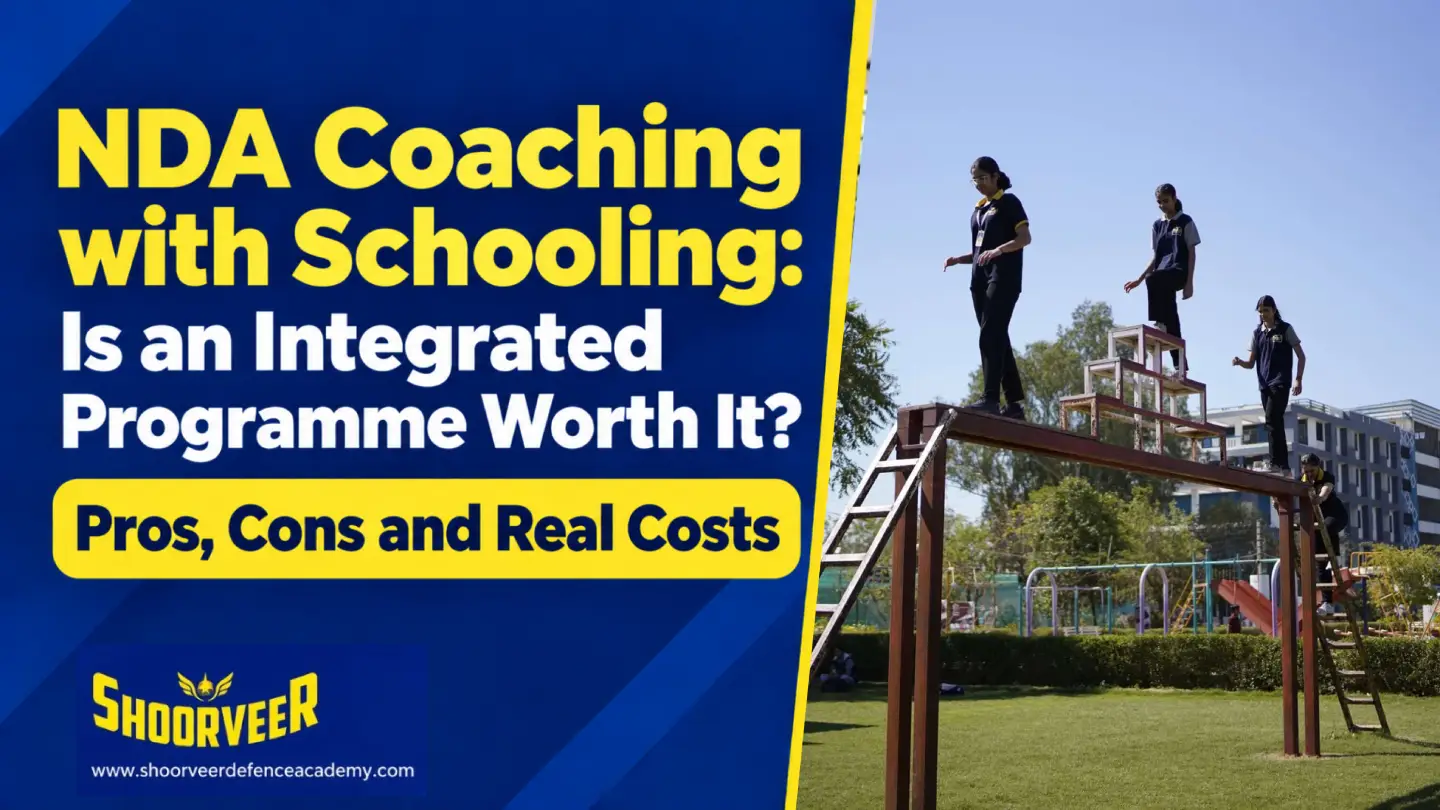
Quick answer: NDA coaching with schooling is worth it when your child is serious about the armed forces, can handle a demanding residential routine, and your family would otherwise pay for school, outside coaching and daily travel anyway. It is not worth it if your child is still undecided about a defence career, needs to live at home, or you cannot get the school’s board affiliation and the fee inclusions confirmed in writing. In Shoorveer Defence Hub’s 2026-27 fee chart, one session costs from ₹2,05,500 (Class 9) to ₹2,51,500 (Class 12).
If you are comparing options, I want to give you the arithmetic and the trade-offs, not a sales pitch. Here is how I would think the decision through.
A quick definition for readers who are new to this: the National Defence Academy (NDA) is the joint training institution of India’s Army, Navy and Air Force. Entry is through a written exam conducted by UPSC, followed by a Services Selection Board (SSB) interview. Candidates can apply while still appearing in Class 12, within an age window of 16.5 to 19.5 years. “NDA coaching with schooling” means one programme that covers the school curriculum and NDA preparation together, instead of a school in one place and a coaching institute in another.
The time maths: school plus outside coaching versus one timetable
Most parents compare fees first. I would compare hours first, because hours are what a 15 or 17 year old cannot get back.
Below is a simple 24-hour ledger. The left column is an illustrative day for a student in a regular school who also attends an outside NDA class. These are my assumptions, so replace them with your own numbers. The right column is the published daily routine at Shoorveer Defence Hub, as listed on its 9th class NDA pre-foundation page and the other batch pages.
| Where the day goes | School plus outside coaching (illustrative) | Integrated programme (published timetable) |
| Sleep | 8 hours | 6.5 hours (lights off 10:30 PM, lights on 5:00 AM) |
| School or classes | 7 hours school + 2.5 hours coaching | 5.5 hours of classes |
| Doubt solving and self-study | 1.5 hours homework | 2 hours doubt solving + 4 hours self-study |
| Physical training and sports | Whatever is left over | 3.5 hours (PT 5:00 to 6:30 AM, sports 5:00 to 7:00 PM) |
| Travel | 2 hours (school plus coaching) | 0 hours |
| Meals | 1.5 hours | 1.5 hours |
| Free gaps | About 1.5 hours, shared with everything else | About 1 hour |
Two things stand out when I run these numbers.
First, the integrated day does not magically add study hours. Timetabled academic time is similar on both sides, roughly 11 to 11.5 hours. What changes is where the other hours go. The two-track student loses about two hours a day to travel, and physical training, which the NDA selection process cares about, becomes whatever energy is left at 8 PM. In the integrated day, PT is on the timetable and travel disappears.
Second, the integrated day costs sleep. From lights-off at 10:30 PM to lights-on at 5:00 AM is 6.5 hours. The American Academy of Sleep Medicine recommends 8 to 10 hours per 24 hours for teenagers aged 13 to 18. I would rather you hear that from me than discover it in month three. If you are considering a Class 9 start, ask exactly how the routine flexes for younger students and after the weekly Sunday test.
There is a third, quieter cost in the two-track route. A student often studies the same Physics and Maths twice, once for school and once for NDA, from two teachers who never compare notes. That duplication is the real argument for integration, and I will come back to it below.
How an integrated NDA programme works
At Shoorveer Defence Hub the idea is simple: CBSE schooling, hostel living and NDA preparation run under one roof on a 35-acre campus in Jhunjhunu. According to the academy’s course pages, the campus includes a 400-metre athletic track, a GTO obstacle course and 19 sports facilities. The programme is organised by class, and each batch has its own name and length:
- Shaurya Batch, Class 9: a four-year route covering Classes 9 to 12.
- Veerta Batch, Class 10: a three-year route, with regular board-pattern tests alongside NDA mocks.
- Abhimanyu Batch, Class 11: a two-year route.
- Yodha Batch, Class 12: a one-year route.
- Khadakwasla Batch, after Class 12: the target batch for students who have passed Class 12, including repeaters.
- Prerna Batch for girls, with a separate girls’ hostel and SSB wing, described on the NDA coaching for girls page.
If you want the full class-by-class view for the Rajasthan campus, I have laid it out in a separate guide on NDA schooling in Rajasthan and its class-wise batches.
A typical weekday, as published, runs like this: PT from 5:00 to 6:30 AM, self-study from 7:30 to 9:00 AM, classes from 9:00 AM to 3:00 PM with a lunch break, doubt solving from 3:00 to 5:00 PM, sports from 5:00 to 7:00 PM and evening self-study from 8:00 to 10:30 PM. Weekends add SSB classes (PPDT, WAT, TAT and GTO), personality development, spoken English, tournaments and a weekly NDA test in Mathematics and the General Ability Test (GAT).
The teaching approach, as the academy describes it, is NDA-focused modules written for the UPSC exam pattern, weekly NDA-pattern mock tests, and doubt-solving sessions built into the day. Whether that works for your child is something you should judge in a conversation and a campus visit, which is why I include a checklist near the end. You can also read more about the people behind the programme on the About Us page.
Boards versus NDA: where the two pull together and where they pull apart
This is the part parents worry about most, so let me be precise about what the NDA actually asks for.
The NDA merit list does not include your board marks. The written exam is 900 marks: Mathematics 300 and the General Ability Test 600. The SSB interview is another 900. The final selection is out of 1,800 marks. A Class 12 pass is a gate you must clear, not a score that is added to your total. That does not mean boards are optional. They protect your child’s Plan B, which is college admission if the NDA does not work out, and they decide whether the child is eligible to join at all.
Stream choice is a real decision. For the Army wing, a Class 12 pass in any stream is enough. For the Air Force and Naval wings, and for the 10+2 Cadet Entry Scheme of the Indian Naval Academy, Physics and Mathematics are required in Class 12. If your child is in Class 9 or 10 today, that is a good reason to pick the PCM stream early and keep every wing open.
The syllabi overlap, but not completely. NDA Mathematics is mostly built on Class 11 and 12 topics such as algebra, trigonometry, calculus and coordinate geometry, so a student who learns them well for CBSE has done much of the NDA work. The GAT adds English, general knowledge, current events and science, and the SSB adds psychology, group tasks and physical standards that no school timetable covers. Integration helps most with the overlap and least with the SSB, which needs its own time.
The calendar can be brutal in a Class 12 year. According to the date sheet CBSE released on 6 November 2026, the Class 12 theory exams in 2027 run from 16 February to 9 April. UPSC’s 2027 calendar lists NDA and NA (I) for 11 April 2027, with the notification due on 2 December 2026 and the last date to apply on 22 December 2026. So the board window closes just two days before the NDA written exam. A student on two separate tracks has to peak twice in quick succession. An integrated programme can sequence revision, board-pattern tests and NDA mocks into one plan. Please confirm the final dates on the UPSC and CBSE websites, because calendars change.
For a deeper look at how one campus handles both, see my companion guide on how a CBSE school with NDA coaching handles boards and NDA together. If your child is already in a regular school and wants practical tips, the older post on how to balance school academics and NDA preparation is a useful read.
The honest trade-offs: pros and cons
Here is the whole picture in one table. I have tried to write the “cost” column as frankly as the “gain” column.
| Factor | What you gain | What it costs you |
| Time | No daily commute, one timetable, no clash between school and coaching | A long day, with little unstructured time |
| Fitness | PT and sports are scheduled every day, with a track and obstacle course on site | Hard training can be heavy for a younger or less active child at first |
| Syllabus | School subjects and NDA subjects are taught together, so Physics and Maths are not studied twice | The school and the coaching are one package, so you cannot swap a weak part for a better one |
| Discipline | A structured day with supervised self-study and doubt solving | Little room for a late start, a bad week or a different rhythm |
| Environment | A peer group that is also aiming at the armed forces | Living away from home, which is hard for some children |
| Cost | One fee and one payment plan instead of three separate bills for school, coaching and transport | A large single bill that is non-refundable once paid, per the 2026-27 chart |
| Focus | Everything points at one goal | If your child changes their mind about a defence career, the programme has been built around the wrong goal |
| Sleep and wellbeing | Fixed routines can build healthy habits | A published sleep window of about 6.5 hours, below the 8 to 10 hours recommended for teenagers |
If you are weighing this against studying alone or with a tutor, I wrote a separate piece on NDA coaching versus self-study. The short version is that structure and mock tests are what coaching buys you, and integration adds the daily routine on top.
The real costs, in rupees
Here are the numbers as they stand on the academy’s published chart. The figures below come from the 2026-27 fee chart on the fee page. The chart is an image, so I have typed the numbers out in text. Always confirm the 2027-28 amounts with the admissions team before you plan around them.
| Batch | Fee per session |
| Class 9 (Shaurya) | ₹2,05,500 |
| Class 10 (Veerta) | ₹2,25,500 |
| Class 11 (Abhimanyu) | ₹2,35,500 |
| Class 12 (Yodha) | ₹2,51,500 |
| After Class 12 (Khadakwasla) | ₹2,07,500 |
A one-time registration fee of ₹10,500 applies to the NDA batches. Paying the full fee at once earns a 5% discount, and otherwise the fee is paid in two instalments within four months.
Because the fee is per session, the total depends on when you join. If the rates stayed exactly as they are in the 2026-27 chart, which they may not:
- A Class 9 start (four sessions) comes to ₹9,18,000, or ₹9,28,500 with the registration fee.
- A Class 11 start (two sessions) comes to ₹4,87,000, or ₹4,97,500 with the registration fee.
- A Class 12 start (one session) comes to ₹2,51,500, or ₹2,62,000 with the registration fee.
Those figures are before the 5% discount and before any extras. Two points in the fee instructions need your attention:
- What the single fee includes. The chart shows one combined fee per batch and does not itemise hostel or mess charges. The course pages describe air-conditioned hostel rooms and in-house meals, so ask for the inclusions in writing.
- What it excludes. According to the academy’s fee instructions, the fee does not cover board registration and exam fees, practical fees, tours, sports tournaments, the annual function, costumes, projects and arts and crafts. Ask about uniform, stationery and travel home as well.
To compare fairly with the two-track route, build the same sum for your own family: school fees, outside NDA coaching fees, books, daily transport, tiffin or meals, and, if you are not in a city with good coaching, the cost of relocating or boarding anyway. For many families outside big cities, the real comparison is not “integrated versus local school plus coaching”. It is “integrated versus a hostel and a separate coaching institute”. Do the sum honestly and you will know which way your family leans. If you would like help with the numbers, you can book a counselling session and ask for a written fee breakdown for your child’s class.
Who an integrated programme suits, and who it does not
It tends to suit a child who:
- Has a settled interest in the armed forces, not just a passing one.
- Is physically active, or willing to build fitness early.
- Can cope with living in a hostel and following a fixed routine.
- Is in Class 8 to 11 and has time to build a base before the exam year.
It tends to suit a family that:
- Lives far from a strong NDA coaching centre.
- Would rather pay one fee than manage school, coaching and transport separately.
- Wants daily PT and SSB practice supervised by trainers, not squeezed in at home.
It may not suit you if:
- Your child is undecided about a defence career. An early, expensive commitment built around one goal is a risk if the goal changes.
- Your child needs to be at home, or struggles with sleep, health or homesickness.
- Your child is already in a strong school with an excellent local NDA coach and a good commute.
- Your child is already deep into Class 12. A full integrated route may be less useful at that stage, and a focused one-year option such as the Class 12 foundation course or the NDA target batch after 12th may fit better.
For girls, the academy describes a separate hostel with 24×7 CCTV, biometric access and female wardens, a girls’ SSB wing and female trainers. I would still ask to see the girls’ hostel and meet the warden during your visit, as I would for any residential programme.
What the evidence says, and what it cannot say
I want to separate what I can verify from what I cannot.
What is verifiable. The NDA structure (900 written marks plus 900 SSB marks), the stream requirements for each wing, the age window and the exam dates are all set by UPSC, so please confirm the latest figures in the official notice at upsc.gov.in. The sleep recommendation comes from the American Academy of Sleep Medicine. The timetable, campus facilities and fees come from the academy’s own published pages.
What I am deliberately not doing. I am not quoting selection numbers in this guide. The figures institutes publish are rarely comparable: some count SSB recommendations, some count final joiners, and some mix years and batches. Before you rely on any result, ask for names, years and the exam cycle, and ask whether the list covers all students or only the best batch. A confident institute will not mind the question.
What nobody can promise. I am not aware of an independent study that compares integrated and two-track NDA preparation head to head. The argument for integration rests on time saved, duplication removed and daily training built in. It is a sensible argument, not a guarantee. Any institute that guarantees selection is telling you something it cannot know.
A decision checklist before you pay
Print this, take it to every visit, and use it on every institute you consider, including ours.
- Do your own time ledger. Write down your child’s real day as it is today, including travel. If hours are the problem, integration helps. If it is not, think twice.
- Verify the school. Ask for the school’s name and CBSE affiliation number, then check them against the board’s records. Course pages say CBSE schooling is on campus, and you should confirm it in writing.
- Get the fee in writing. Ask what the single fee includes and excludes, what extras you will pay each year, and whether the rate is fixed across sessions.
- Read the refund and exit terms. The 2026-27 chart says fees are non-refundable once deposited. Ask what happens if your child leaves after a month.
- Ask for your child’s real weekly timetable. Include wake-up time, lights-off, Sunday tests and what changes for younger students.
- Meet the trainers. Ask about the PT staff’s qualifications and the SSB instructors’ backgrounds, and ask to watch a session.
- Check the subjects. If your child wants the Air Force or Navy, confirm they will study Physics and Mathematics in Class 12.
- Look at board results by batch. Ask for Class 10 and Class 12 results for past batches, with years.
- Ask for named, dated NDA results. See the section above for how to read them.
- Visit and talk to current parents. Eat a meal in the mess, see the hostel at an ordinary hour and ask the children how they sleep.
- Decide who owns the Plan B. Ask how the school side supports a student who decides not to pursue the NDA.
If you would like to walk through this checklist with a counsellor, book a counselling session or ask about the SSB coaching programme if the interview round is your main concern. Counsellors can also be reached on +91-7240372408.
Frequently asked questions
1. Is NDA coaching with schooling worth it?
It is worth it when your child is committed to a defence career, can handle a demanding residential routine, and your family would otherwise pay for school, coaching and travel separately. It saves commuting time and builds daily training into the timetable. It is not worth it if your child is undecided or you cannot confirm the fees and school affiliation in writing.
2. What is NDA coaching with schooling?
It is an integrated programme where a student follows a board-aligned school curriculum and NDA preparation under one timetable, usually on one residential campus. The programme typically covers the school syllabus, the UPSC written exam (Mathematics and General Ability Test), SSB interview training and daily physical training.
3. How much does NDA coaching with schooling cost in India?
At Shoorveer Defence Hub, the 2026-27 chart lists ₹2,05,500 per session for Class 9, ₹2,25,500 for Class 10, ₹2,35,500 for Class 11, ₹2,51,500 for Class 12 and ₹2,07,500 for the after-12th batch, plus a one-time ₹10,500 registration fee. Confirm the 2027-28 amounts and what the fee includes before you pay.
4. Is integrated NDA coaching better than separate school and coaching?
It depends on the student. An integrated programme saves travel time, teaches overlapping subjects together and schedules fitness and SSB practice daily. Separate coaching offers more flexibility, more choice of school and the chance to stay at home. Compare your child’s daily hours, budget and ability to live away from home.
5. Can I prepare for the NDA while attending a regular school?
Yes, many aspirants do, using evening classes or online coaching. The challenge is time. Travel, homework and studying the same Physics and Maths twice often leave only an hour or two a day for NDA-specific study and fitness. It works best for self-disciplined students who live near a strong coach.
6. Do board marks matter for NDA selection?
Board marks are not added to the NDA merit list, which is out of 1,800 marks: 900 for the written exam and 900 for the SSB interview. But candidates must pass Class 12 to join, and good board marks protect your child’s college options if they do not get selected.
7. Which stream should I choose for the NDA?
For the Army wing, any stream passes the eligibility rule. For the Air Force and Naval wings, and the 10+2 Cadet Entry Scheme at the Indian Naval Academy, you need Physics and Mathematics in Class 12. Choosing the science stream with Mathematics keeps every wing open.
8. Can I start NDA coaching with schooling in Class 11 or only in Class 9?
You can join at several points. The academy runs a four-year route from Class 9, a three-year route from Class 10, a two-year route from Class 11 and a one-year route in Class 12, plus a target batch after Class 12. An earlier start gives more time to build fitness and fundamentals.
9. Is NDA coaching with schooling safe for girls?
The academy describes a separate girls’ hostel with 24×7 CCTV, biometric access and female wardens, plus a girls’ SSB wing and female trainers. Safety claims should always be verified in person, so visit the hostel, meet the warden and speak to current parents before you decide.
10. What if my child does not clear the NDA?
The NDA exam is held twice a year and the age window runs from 16.5 to 19.5, so there are usually a few chances. Board results from the school side keep college options open, and other defence entries exist. Ask any institute how it supports a student who decides on a different path.
11. Is a residential NDA programme too intense for a Class 9 student?
It can be, which is why I recommend asking for the real timetable. The published routine runs from 5:00 AM to 10:30 PM, which leaves about 6.5 hours of sleep. The American Academy of Sleep Medicine recommends 8 to 10 hours for teenagers 13 to 18. Ask how the routine flexes for younger students.
Book counselling
If this decision is on your table right now, the most useful next step is a conversation with the numbers in front of you. Book a counselling session with the Shoorveer Defence Hub admissions team, bring your child’s current timetable and ask for a written fee breakdown for the batch you are considering. You can also read the About Us page to learn who is on the team, and check the fee page for the latest chart.
1 Comment
Comments are closed.